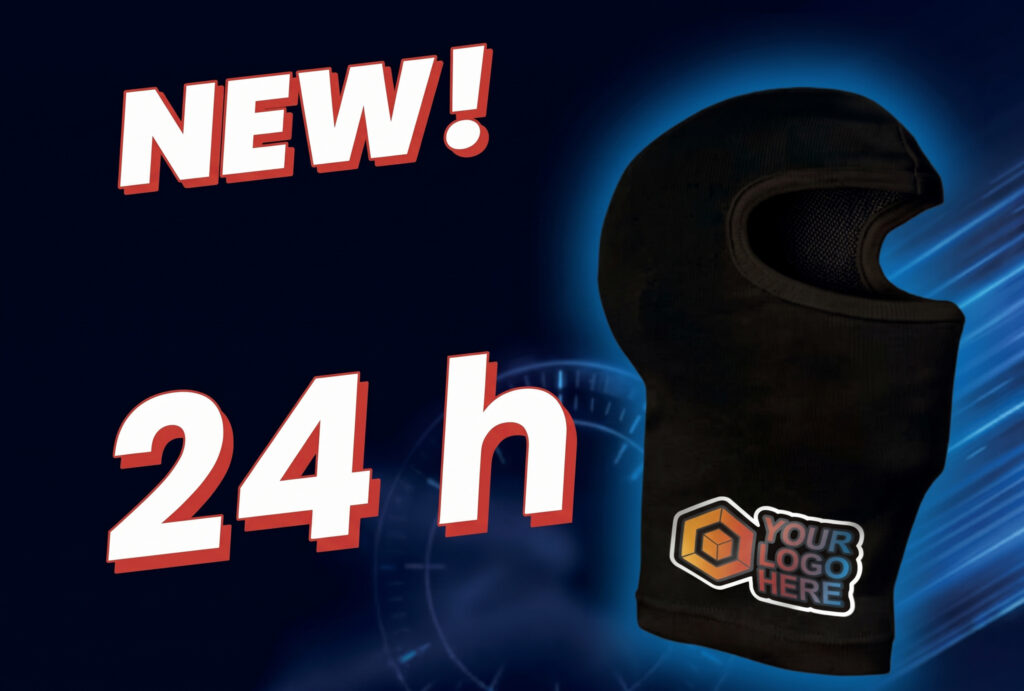
Personalized balaclavas, scarves and gloves are not only about design, but above all about the right technology. In order for the branding on your accessories to build the prestige of the track and not generate complaints, you need to understand what types of printing on balaclavas will work in specific operating conditions. The choice of method depends on three parameters:
Material compatibility: One method is designed for cotton (breathable screen printing/DTF), and another for polyester (indestructible sublimation).
Flexibility and hand feel: The logo must not crack when applied or create a stiff, irritating barrier on the customer's skin.
Mechanical resistance: The print must withstand friction against the helmet lining and dozens of wash cycles at high temperatures.
Working with a supplier who has their own machine park and verifies your graphic files in terms of vector graphics allows you to avoid 90% of problems, such as logos coming unstuck or sponsors being dissatisfied due to incorrect colors.
table of contents
1. Material architecture and printing technology
Before we analyze specific types of prints on balaclavas, we need to understand how the base materials differ from each other. In the world of karting, we mainly work with two types of fabric: cotton and technical polyester.
We have provided a detailed description of the specific uses of each type of fiber and their actual performance under track conditions in our comparison of the differences between polyester and cotton balaclavas.
Cotton – Natural absorbency and mechanical challenges
Cotton is a cellulose fiber with a porous structure. This makes it ideal for water-based and plastisol inks, which penetrate deep between the weaves. However, cotton is a "living" material – under the influence of moisture and temperature, the fibers swell and may shrink after washing. The print must be highly elastic in order to "work" together with the fabric. If we use paint that is too hard without the appropriate plasticizers, after just a few uses, a characteristic "spider web" of cracks will appear on the logo, which will destroy the visual effect and prestige of your brand.
Polyester – Synthetic smoothness and dye diffusion
The technical polyester used to manufacture balaclavas is a material with smooth, closed fibers. It does not absorb liquids in the same way as cotton, which means that classic dyes may have problems with adhesion. In this case, the dye must either be permanently bonded to the surface using special polymer adhesives (DTF) or introduced into the molecular structure of the fiber (sublimation).
2. Screen printing – a classic solution for balaclavas
Screen printing is one of the oldest and most proven methods of marking clothing, which still dominates wholesale orders for karting tracks. The process involves pressing ink through a specially prepared matrix (screen) directly onto the fabric.
Why is screen printing cost-effective for tracks?
The main factor here is economies of scale. Preparing the matrices (screen exposure) generates a fixed cost, which becomes negligible when ordering 500 or 1,000 balaclavas . This makes the unit price of branding unbeatable.
Technical aspects of screen printing on cotton:
High pigmentation: Screen printing inks are characterized by high saturation. The track logo on black cotton will be perfectly white or intensely colored, without the background color showing through.
Chemical durability: After the paint is applied, the product goes through a drying tunnel, where polymerization takes place at a temperature of approx. 160°C. This makes the print an integral part of the material, resistant to friction against the inside of the helmet.
However, since the material comes into direct contact with the driver’s damp skin for many hours, the plastisol and water-based inks used must strictly comply with the rigorous REACH safety standards and Safety Gate guidelines to completely eliminate the risk of allergic reactions.
Main features of screen printing:
Cotton has a dense, natural structure that absorbs screen printing ink very well. Due to this the print:
-
is durable,
-
has intense colors,
-
withstands washing and daily use well.
Screen printing works best for:
-
track logo,
-
simple graphics,
-
uniform colors,
-
higher production costs.
Advantages of screen printing on cotton balaclavas:
-
high print durability,
-
very good color quality,
-
favorable cost for larger quantities,
-
classic, aesthetic effect.
Limitations:
-
less profitable for very small series,
-
limited number of colors in a single design,
-
no possibility of full printing over the entire surface.
3. DTF (Direct To Film) – a universal solution for cotton and knitted gloves
When analyzing modern types of printing on balaclavas, it is impossible to overlook DTF technology. It is a transfer method: the graphic is digitally printed on a special PET film, then sprinkled with powdered hot melt adhesive (TPU) and gelled. The transfer prepared in this way is heat-pressed onto the product using a press.
A breakthrough in the labeling of knitted gloves
Karting gloves for amateurs, often made of elastic fabric, have always been a challenge for screen printing. The loose weave caused the ink to soak in too deeply, making the logo blurry. DTF creates a thin, incredibly flexible membrane on the surface that perfectly reproduces even the most complex sponsor logos.
Importantly, for facilities investing in custom-printed go-kart gloves, this technology allows the design to be applied exclusively to the back of the hand, leaving the palm—with its black non-slip rubber—completely intact.
Shape memory and biomechanics of printing
The key to DTF's success is TPU polyurethane adhesive. This material has phenomenal "shape memory." When the driver pulls on the balaclava, the print stretches with the material, and when removed, it returns to its original shape without any permanent deformation.
What makes DTF stand out?
The print is first printed on a special film and then transferred to the product using a heat press. This allows for:
-
great design freedom,
-
highly accurate reproduction of details,
-
multicolor and even photographic prints.
DTF on cotton balaclavas
It is a great alternative to screen printing, especially when:
-
orders are smaller,
-
the design contains many colors,
-
the graphics are more complex.
DTF on knitted gloves
Knitted gloves have a specific, elastic structure. DTF allows for precise printing without interfering with the fabric itself.
Advantages of DTF:
-
full-color printing capability,
-
good print flexibility,
-
ideal for short runs and personalization,
-
high repeatability of quality.
Limitations:
-
the print is noticeable under your finger,
-
reduced breathability at the application site,
When to choose DTF?
- For smaller orders (even as few as 10-20 items).
- When the logo is very complex, has many colors, shading, or details smaller than 1 mm.
- When marking knitted gloves.
4. Sublimation – complete design freedom for polyester
Sublimation is the most advanced process for decorating polyester materials. Under the influence of high temperature (approx. 190°C), the dye changes its state from solid to gas, penetrating directly into the synthetic fibers, which "open" their pores at this temperature.
Why is sublimation considered "permanent"?
Because the dye is not "on" the material, but becomes part of it. The print is completely imperceptible to the touch (so-called zero-feel print). There is no physical possibility for the sublimation print to crack, peel, or fade under the influence of sweat.
Full-print 360° strategy
Unlike screen printing or DTF, sublimation allows the entire surface of the material to be printed before it is sewn. This opens up incredible marketing opportunities for the track owner:
-
balaclavas racing helmets or the faces of competitors.
-
scarves covered with a 100% carbon pattern or chequered flag.
-
Place sponsor logos anywhere without worrying about seams.
Impact on hygiene: Studies (Effect of Sublimation Transfer Printing on Moisture Management Properties) show that sublimation does not block the pores of the material in any way. This means that balaclava retains 100% of its breathability after printing.
Source: Effect of Sublimation Transfer Printing on Moisture Management Properties
Sublimation on thermoactive balaclavas
This is the perfect solution for products that are used intensively. The print does not affect the thermoactive properties, while allowing for the creation of modern, dynamic designs.
Sublimation on multifunctional scarves
A scarf is a product that is simply "made" for sublimation. Full 360° printing is possible, with no color or design restrictions.
Advantages of sublimation:
-
possibility of printing on the entire surface of the product,
-
any number of colors and patterns,
-
no noticeable print,
-
maximum durability,
-
complete creative freedom.
Limitations:
-
Not suitable for cotton.
When to choose sublimation?
- For polyester products (scarves , balaclavas ).
- When you want to achieve a "full-print" effect across the entire surface.
- When you want a product that will look like new after 100 washes.
5. The most common mistakes when ordering prints – how to avoid them?
Choosing the right type of print for balaclavas is half the battle. The other half is preparing the process correctly. As a track owner, you should avoid three cardinal mistakes:
Mistake 1: Ignoring vector formats
Sending a logo in .jpg or .png format downloaded from Facebook is the easiest way to end up with an unsightly print. Professional machines require vectors (.ai, .eps, .pdf). Only these allow you to achieve perfectly sharp edges that demonstrate the professionalism of your facility.
Mistake 2: Lack of color standardization (CMYK vs. RGB)
Your logo on a computer screen (RGB) will always look different than on fabric. To avoid disappointment, always use the CMYK scale or provide specific Pantone numbers. Only then will the logo on the balaclava be identical to the color of your go-karts or service suits. However, remember that not every company operates in a given color palette, and there is always a chance that the color will have to be rechecked.
Mistake 3: Designing "at the seams"
Although sublimation copes with this better, in the case of screen printing and DTF, printing on the seam is asking for trouble. An unevenness forms at the stitching point, which can cause local underheating of the adhesive or cracking of the ink. In addition, thick printing on the seam can pinch the customer under a tight-fitting helmet, spoiling the comfort of riding.
Summary
Choosing a marking technology is a strategic balance between effort, budget, and customer expectations. Conscious management of this process will allow you to avoid complaints and build a professional image for your track.
-
Choose screen printing if your priority is mass availability balaclavas while maintaining the lowest cost and high aesthetics of the logo.
-
Choose DTF if you are looking for personalization, smaller event series, or need durable prints on knitted gloves with complex patterns.
-
Choose Sublimation if your goal is to build a premium brand, sell attractive full-print merchandise, and offer your customers products with the highest possible durability.
Remember that balaclava professionally made balaclava your track’s logo is more than just helmet protection —it’s your mobile business card, which often ends up in customers’ homes after the race, helping to build your brand recognition for months to come.
FAQ
What determines the choice of printing technology for balaclavas?
The choice depends on three main parameters: the type of material (cotton vs. polyester), the desired elasticity (the print must not crack or scratch), and mechanical resistance to friction inside the helmet and frequent washing.
Why is screen printing so popular for balaclavas ?
Screen printing is most economical for large print runs (e.g., 500-1000 pieces). It offers very high color intensity that does not show through on dark backgrounds, and high durability thanks to high-temperature polymerization of the ink.
What are the limitations of screen printing?
This method is less cost-effective for small batches due to the cost of preparing the dies. It also has a limited number of colors in a single design and does not allow for printing the entire surface of the product (so-called full-print).
When is it best to choose DTF technology?
DTF is ideal for small orders (as few as 10-20 pieces), complex, multicolored logos, and for marking knitted gloves, where precise reproduction of details on elastic fabric is crucial.
Why is sublimation called "permanent" printing?
In sublimation, the dye penetrates directly into the molecular structure of the polyester fibers under the influence of temperature. The print is not noticeable to the touch, does not crack, does not wash out, and does not fade, as it becomes an integral part of the fabric.
What possibilities does Full-print 360° technology offer?
The technology available for sublimation allows the entire surface to be printed before stitching. You can create balaclavas helmets, athletes' faces, or carbon patterns without worrying about blocking the breathability of the material.
Can printing impair the hygiene of balaclavas ?
In the case of sublimation – no. Research shows that sublimation dye does not block the pores of the material, allowing balaclava 100% of its sweat-wicking properties.
What mistakes should be avoided when sending a logo?
The biggest mistake is sending files in bitmap format (.jpg, .png). Professional printing requires vector formats (.ai, .eps, .pdf), which guarantee perfectly sharp edges regardless of magnification.
Why should you avoid designing prints on seams?
An uneven surface forms at the seam, which can lead to the adhesive not heating up properly (DTF) or the paint cracking (screen printing). In addition, thick printing on the seam can cause painful pressure under a tight-fitting helmet.
Sources:
- M. S. Kralj et al., pH-Responsive Carboxymethylcellulose Nanoparticles for ⁶⁸Ga-WBC Labeling in PET Imaging, Polymers, 2019, 11(10), 1615.
A. K. Samanta et al., Influence of sublimation process on air permeability and water absorption dynamics, International Journal of Clothing Science and Technology, 2021, 33(6).