The Complete Guide to Karting Flags: Signals That Protect Your Business and Equipment
What flags are used at go-kart tracks?
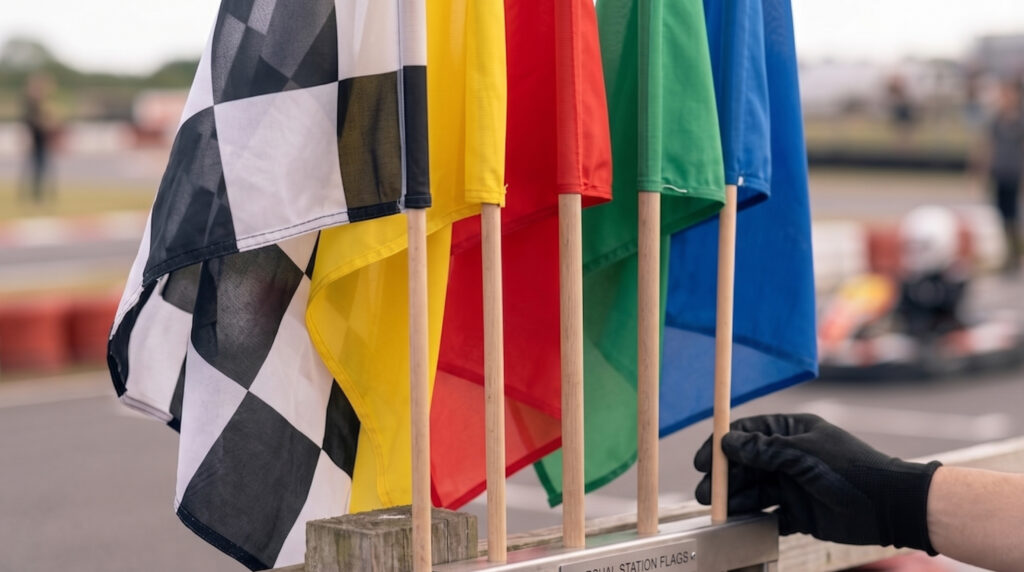
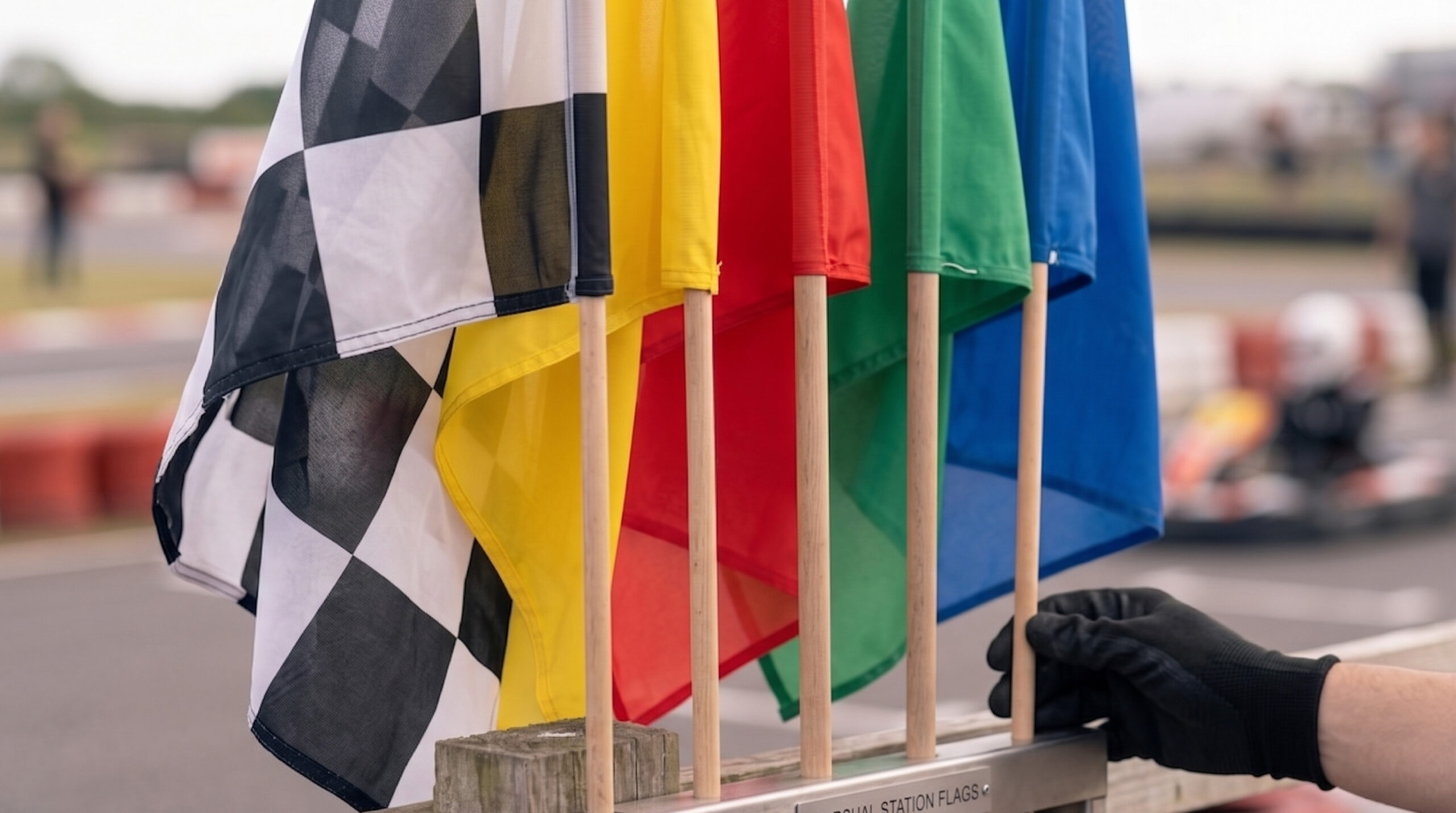
Nine flags are used on the go-kart track:
- green (start / track clear),
- yellow (danger),
- red (immediate stop),
- blue (passing),
- white (slow vehicle),
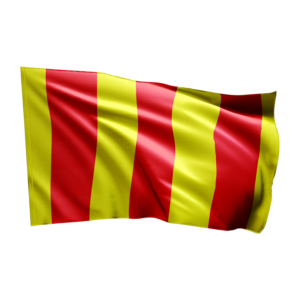
- yellow and red stripes (slippery surface),
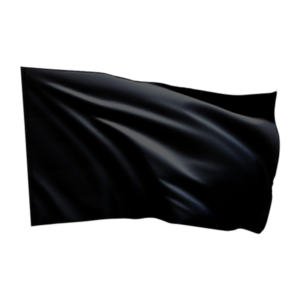
- black (disqualification),
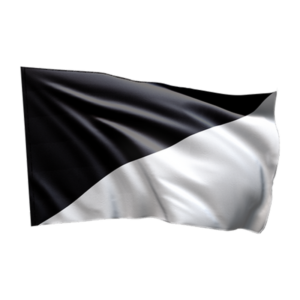
- black and white (warning) and
- chequerboard (end of session).
Below you’ll find more detailed information on what each of these means for the driver—and why their absence or poor quality costs the track operator.
Key information about flags for go-kart track operators—at a glance
- Safety: Research on visual safety communication shows that optimizing contrast, standardizing symbols, and establishing an information hierarchy improves attention capture by 35.9% and hazard detection accuracy by 42.3%.Source: Weng, Y., Ren, Q. Visual communication design of safety flags in karting tracks based on visual attention
- All flags: From green (start) to chequered (finish)—each one affects the session’s smoothness and ROI.
- Costs: Signaling errors are one of the key factors contributing to track accidents, resulting in repair and downtime costs.
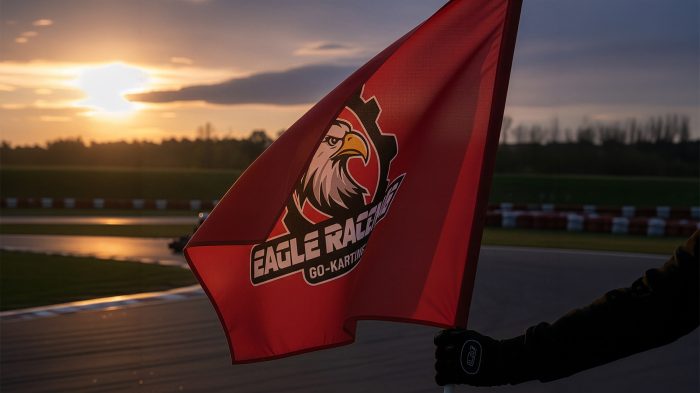
- Branding: Flags featuring the track’s logo (full-print) and printed balaclavas convey a sense of professionalism that shines through in every photo from the shoot.
table of contents
1. Are flags required on the kart-rental track?
A kart-rental track is an amateur facility not directly subject to FIA regulations. However, this does not mean that the operator is not bound by any standards. In many European countries, there is no separate law regulating exclusively amateur karting tracks—which is why courts and insurers rely on established industry guidelines, such as the British Association of Racing Kart Schools (ARKS) manual or FIA Appendix H to the International Sporting Code.
Under EU Regulation 2023/988(General Product Safety Regulation), service providers are required to ensure safety based on recognized standards in the absence of specific national regulations. In practice, this means that the lack of standardized signage is treated by insurers and forensic experts as gross negligence. The same GPSR compliance requirement also applies to other customer-facing accessories—find out what a track operator should know about REACH standards and balaclavas certification.

Practical implication: Even if there is no specific legal requirement for flags, their absence in the event of an accident will work against the karting track owner.
Important! This article is for informational purposes only. For questions regarding the legal regulations governing signaling on kart-rental tracks in your area, please consult a legal advisor.
2. Why are flags important at a go-kart track?
Karting flags are a visual safety management system that replaces verbal communication in high-noise environments (approx. 90–100 dB). Their importance is particularly significant on rental tracks: drivers are inexperienced and, under the influence of adrenaline, often ignore verbal instructions given during the briefing.
What does research say about the effectiveness of visual cues?
attention-grabbing effectiveness
+42,3%
threat detection accuracy
+38,7%
compliance rate
(adherence to instructions)
Although the study focused on safety signs in laboratories, the principles of visual perception are universal: high contrast, standardization, and a clear hierarchy are just as effective on a racetrack as they are in a laboratory. Faded flags, those with low color saturation, or non-standard sizes reduce the effectiveness of signaling—regardless of the environment.
3. Race and Start Flags: Green, Yellow, and Red
These flags set the pace of the session—they indicate whether the track is active, hazardous, or whether driving must be suspended. Their clarity determines how quickly staff and drivers can react.
▸ Green flag — start and clear track
A green flag indicates that the track is clear and the session or race is about to begin. It is also displayed once the yellow-flagged caution period has ended—as confirmation that normal racing conditions have resumed.

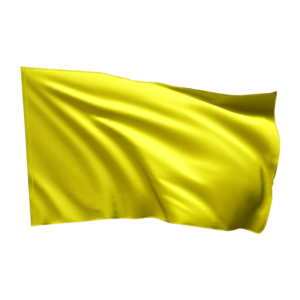
▸ Yellow flag — danger
A yellow flag signals danger on the track or in its immediate vicinity. It requires drivers to slow down and strictly prohibits overtaking. It is the most commonly used flag on rental tracks—it is displayed whenever there is a collision, a driver goes off the track, or a go-kart breaks down.
The right shade of yellow and high background contrast are crucial. Research by Weng and Ren (2025) shows that an optimized visual system (contrast, standardization, hierarchy) improves hazard detection accuracy by 42.3%—an effect achieved through the properties of the entire sign system, not the color itself.
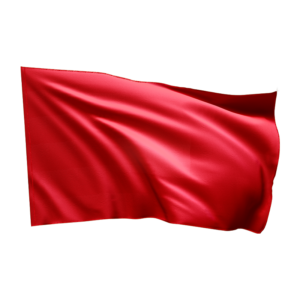
▸ Red flag — immediate stoppage of the race
A red flag signals an immediate stop to the session. All drivers must slow down and stop at the designated area or pull over safely into the pit lane. A red flag is displayed in the event of serious accidents, obstacles blocking the track, or life-threatening situations.
Misinterpretations of this flag are the cause of the most serious incidents on the track. According to the regulations CIK-FIA and Appendix H to the FIA Sporting Code, the red flag takes precedence over all other signals.
4. Information and technical flags: Blue, White, and Yellow-Red
These flags do not interrupt the session, but they do affect riding technique and the smoothness of movement.
▸ Blue Flag — overtaking
The blue flag signals to the driver that a faster competitor is catching up and that they must allow the competitor to pass. On rental tracks, proper use of the blue flag directly translates to greater satisfaction among more experienced customers—it prevents frustration caused by slower drivers blocking the track.
The clear and consistent color scheme of the blue flag is important: research by Weng and Ren (2025) shows that visual standardization of the signaling system improves compliance rates by 37.8%.

▸ White flag — slow vehicle
A white flag indicates that there is a much slower vehicle on the track—this could be a support vehicle or a go-kart with a serious mechanical failure. Drivers should exercise extreme caution and avoid attempting to pass near it.

▸ Yellow-and-red flag (striped) — slippery surface
A yellow-and-red striped flag warns of a slippery surface—oil, water, sand, or other debris. It requires drivers to immediately reduce their speed and proceed with caution through the hazardous section.
In accordance with the guidelines Association of Racing Kart Schools (ARKS, 2025), this flag must be displayed for a minimum of 4 laps after a hazard is identified or until the hazard is removed and drivers have adjusted their speed. The color fastness of the striped flag is of particular importance—a faded pattern can be mistaken for a yellow or white flag.
5. Referee and penalty flags: Black and warning flags
These flags serve to rein in aggressive or dangerous drivers and remove damaged vehicles from the track.
▸Black flag – disqualification
A black flag orders the driver to immediately pull into the pit lane and end the session. On rental tracks, it is used against drivers who drive extremely aggressively or repeatedly violate the rules. It is often displayed alongside the kart’s number or a number plate.
▸Black-and-white flag (diagonal) – warning
A black-and-white flag is a warning for unsportsmanlike conduct. If the driver does not change his driving style after it is displayed, the next signal will be a black flag.
▸Black flag with an orange circle (Meatball) – technical issue
A black flag with an orange circle indicates a technical problem with the kart that poses a safety hazard—most commonly a loose bumper, a damaged fairing, or a fluid leak. The driver must pull over to the pit immediately.
Failure to respond to this signal constitutes a violation of risk management standards for motorsport events, as set forth in HSE HSG112(Health and Safety Executive, UK). For the track operator, this entails direct liability for any damage resulting from allowing a malfunctioning vehicle to continue driving.

The black-and-white chequered flag signals the official end of the race or session. After passing it, the driver must complete a cool-down lap at a moderate speed.

For a go-kart track operator, the chequered flag is a key selling point. It’s the one that appears in photos of the winners posted on social media.
Consistent branding—flags, balaclavas gloves featuring the same logo—ensures that every photo like this helps build the track’s brand recognition. Find out how balaclavas logo-printed accessories help build a karting facility’s brand.
A flag featuring the track’s logo, printed using the sublimation method, appears in every photo—it’s free brand exposure with every session.
6. List of karting flags
| Flag | Function | Technical requirement | Benefit for the operator |
|---|---|---|---|
| Green | Start / Clear Track | High contrast, rich green | A smooth start to the session, no confusion |
| Yellow | Danger | CIK-FIA standard, min. 60×80 cm | Reducing collisions and repair costs |
| Red | End session | Precedence over other flags | Compliance with GPSR requirements |
| Blue | Overtaking | 360° visibility, pure color | Satisfaction among advanced customers |
| White | Slow vehicle | Pure white with no undertones | Preventing collisions with staff |
| Striped | Slippery surface | Color fastness (sublimation), min. 4 cycles | Protecting engines, tires, and customers |
| Black | Disqualification | Visible next to the go-kart number | A tool for discipline |
| Black and white | Warning | Visible diagonal | The stage before disqualification |
| Meatball | Technical defect | Orange circle, at least 20 cm in diameter | Compliance with HSE HSG112 |
| Chequerboard | End of session | Sublimation printing, track logo | Free marketing (UGC) |
7. Why are custom flags featuring a track logo the industry standard in kart rental?
A flag isn't just a symbol— it's part of your brand's ecosystem.
A customer who sees staff using flags bearing the track's logo and receives a balaclava and gloves with the same logo perceives the value of the service as higher than in a place where everything is anonymous.
Find out why balaclava a logo sells better than a plain one—and how that affects your profit margin.
Market data shows that facilities that invest in consistent branding (full-print banners, personalized accessories) can raise session prices by 10–15% while increasing customer loyalty. A chequerboard featuring a logo serves as advertising—at no additional cost.
FAQ
Does a go-kart track have to use flags?
In many countries, there are no laws that explicitly impose this obligation. In practice, however, insurers and courts treat the lack of standardized signage as gross negligence on the part of the operator—especially in the event of an accident. The CIK-FIA guidelines and Appendix H to the FIA Sporting Code serve as the primary reference.
What is the difference between a black flag and a black-and-white flag?
A black-and-white flag (split diagonally) is a warning for unsportsmanlike conduct—the driver is given one last chance to change his driving style. A black flag results in disqualification: the driver must pull into the pit lane and is not allowed to return to the track for the remainder of the session.
How long should the yellow-and-red flag be displayed?
In accordance with ARKS guidelines (2025), for a minimum of 4 laps from the moment the debris is detected or until the hazard is physically removed and the drivers adjust their pace.
Do the flags at a go-kart track have to meet FIA standards?
FIA regulations (CIK-FIA, Appendix H) apply directly to federation-sanctioned races. For rental tracks, they serve as a benchmark for best practices—adhering to their standards for colors, dimensions, and procedures provides the strongest defense in the event of an inspection or a dispute with an insurer.
What is the best material for karting flags?
Flags intended for heavy-duty use should be made of polyester fabric with a sublimation print. Sublimation ensures color fastness regardless of washing and UV exposure—a faded flag loses both its signaling function and its branding value.